
Without blocking the ANOVA has 24 16 treatments but with n 2 replicates the MSE would have 16 degrees of freedom. 921 The 3 k Factorial Design.
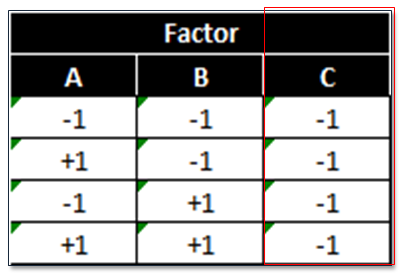
Fractional Factorial Designs With Minitab Lean Sigma Corporation
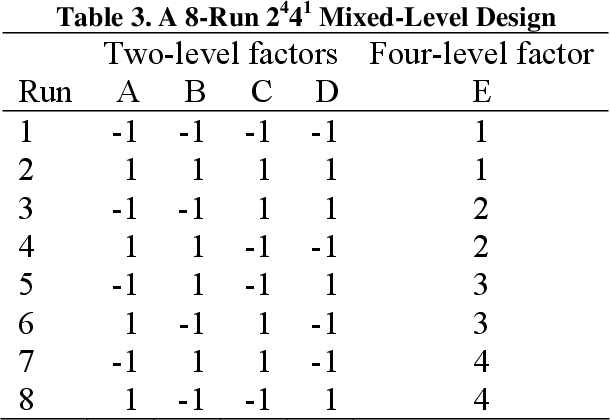
Efficient Mixed Level Fractional Factorial Designs Evaluation Augmentation And Application Semantic Scholar

Factorial Experiment Wikipedia
Remember that for Y the larger the.
3 level fractional factorial design. Mixed level designs have some factors with say 2 levels and some with 3 levels or 4 levels. B the fractional factorial design involves 2 31 2 2 4 experimental conditions. How Many trials in a Full Factorial Design.
From Number of replicates for corner points select 3. This notation contains the following information. When parameter a is at level 1 parameter b is tested at level 1 twice level 2 twice and level 3 twice twice for all 3 levels.
There are three generators since this is a 18 2-3 fraction in general a 2 k-p fractional factorial needs p generators which define the settings for p additional factor columns to be added to the 2 k-p full factorial design columns - see the following detailed description for the 2 8-3 design. This design will yield information about the _____ a The design has 12 independent variables b The design has two independent variables at level A three independent variables at level B and two independent variables at level c. 914 The General 3 k Design 340.
A the corresponding complete factorial design is 2 3 in other words involves 3 factors each of which has 2 levels for a total of 8 experimental conditions. For example a 2-level full factorial design with 6 factors requires 64 runs. This course will cover the benefits of fractional factorials along with methods for constructing and analyzing the data from these experiments.
As the number of factors of interest grows full factorials become too expensive and fractional versions of the factorial design are useful. A design of 4 factors with 3 levels each would be. Between 1 and 3 b.
2k-p Fractional Factorial Design When the number of factors is large a full factorial design requires a large number of experiments In that case fractional factorial design can be used Requires fewer experiments eg 2k-1 requires half of the experiments as a full factorial design. Standard two-level full and fractional factorials up to 512 runs for testing up to 21 factors simultaneously now also with minimum-aberration blocking choices General multilevel factorial designs up to 32000 runs using factors with mixed levels. The total number of experiments is selected to be the minimum from the Plackett-Burman design 12 experiments Table 3.
3 x 3 x 3 x 3 34 81. Found by taking the number of levels as the base and the number of factors as the exponent. In order to select a 18 fraction of the full factorial we will need to choose 3 generators and make sure that the generalized interactions among these three generators are of sufficient size to achieve the higher resolution.
Such as fractional factorial designs to reduce this. Between 3 and 5 c. As the number of factors in a 2-level factorial design increases the number of runs necessary to do a full factorial design increases quickly.
The same thing holds when parameter a is at level 2 or level 3. In this example because you are performing a factorial design with two factors you have only one option a full factorial design with four experimental runs. Similarly parameters c and d are tested twice at levels 1 2 and 3 all L levels.
911 Notation and Motivation for the 3 k Design 333. In a factorial design one obtains data at every combination of the levels. Whilst the level is the subdivision of a factor.
912 The 3 2 Design 334. A full factorial design sometimes seems to be tedious and requires a large number of samples. The 2 k and 3 k experiments are special cases of factorial designs.
At least 6 d. For example with two factors each taking two levels a factorial experiment would have four treatment combinations in total and is usually called a 22 factorial design. Performing the anova using factors A C and D and the interaction terms AC and AD gives the results shown in the table which are very similar to the results for the full factorial experiment experiment but have the advantage of requiring only a half-fraction 8 runs rather than 16.
Approaches to Experimentation What is Design of Experiments Definition of DOE Why DOE History of DOE Basic DOE Example Factors Levels Responses General Model of Process or System Interaction Randomization Blocking Replication Experiment Design Process Types of DOE One factorial Two factorial Fractional factorial Screening experiments Calculation of Alias DOE Selection Guide. A factorial design is often used by scientists wishing to understand the effect of two or more independent variables upon a single dependent variable. Box-Behnken bbdesign Central-Composite ccdesign Randomized Designs.
To give a simple example if we have four factors the 2k design has 16 treatment combinations so say we plan to do just two replicates of the design. 92 Confounding in the 3 k Factorial Design 340. 3 discussions some knowledge of the design of two-level fractional factorial experiments will be assumed.
A design with 9 factors requires 512 runs. CONTENTS xi 103 Power and Sample Size. Having completed the two-level full factorial experiment lets turn to the Plackett-Burman experiment for comparison.
235 104 Two-Series Factorials. 913 The 3 3 Design 335. If the number of combinations in a full factorial design is too high to be logistically feasible a fractional factorial design may be done in which some of the possible combinations usually at least half are omitted.
There are other designs that you can use such as a fractional factorial which uses only a fraction of the total runs. Consider another example the P 5 L 3 case on the next page. In this experiment five factors with two levels are considered.
A half-fraction fractional factorial design would require only half of those runs. Dropping B results in a full factorial 2 3 design for the factors A C and D. X F n level count.
12 or Montgomery 1997 Ch. 9 Additional Design and Analysis Topics for Factorial and Fractional Factorial Designs 332. A 2-level design with two factors has 2 2 four possible factor combinations.
General Full-Factorial fullfact 2-Level Full-Factorial ff2n 2-Level Fractional-Factorial fracfact Plackett-Burman pbdesign Response-Surface Designs. In our coating example we would call this design a 2 level 3 factor full factorial DOE. The number of runs would then be calculated as 23 or 2x2x2 which equals 8 total runs.
A fractional design would allow the reduction of experiments from the full factorial with the sacrifice in minor higher level interaction and nonlinearity effects. For more information on the design techniques for 2 k-p designs see Box Hunter and Hunter 1978 Ch. First we will look at an example with 6 factors and we select a 26-3 design or a 18th fractional factorial of a 26 design.
Of trials F 1 level count x F 2 level count x. 4 factors A3 B 2 C5 D 4 levels. And c this fractional factorial design is a 2 1 12 fraction of the complete factorial.
The recommended number of center points to add to an un-replicated two-level factorial or fractional design is a. Click OK to return to the main dialog box. One of the researchers from IIT kharagpur conducted a 2x3x2 factorial design experiment for variables ABC.
91 The 3 k Factorial Design 333.
Afit Edu

Fractional Factorial Design For The Guide To Decide Project Download Table

Fractional Factorial Designs
Solved Fractional Factorials With Categorical 2 Level And 3 Level Factors Jmp User Community

Solved Fractional Factorials With Categorical 2 Level And 3 Level Factors Jmp User Community

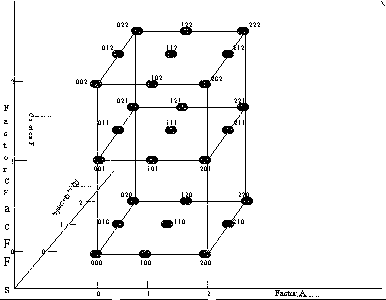
5 3 3 9 Three Level Full Factorial Designs
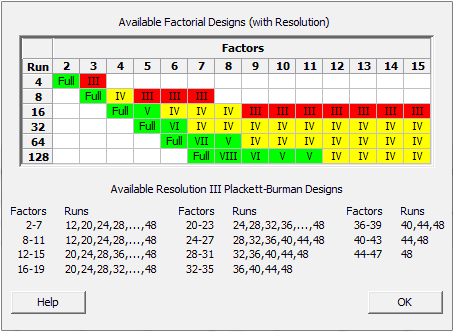
Design Of Experiments Fractionating And Folding A Doe
1


